

Type a single made-up-sounding word into Google and watch a dozen “complete guides” appear overnight, each one confidently defining something that didn’t exist in any dictionary six months ago. That’s exactly what’s happening right now with newtopy, a buzzword making the rounds on blogs, forums, and AI-generated content farms. People are searching for it, clicking through, and walking away more confused than when they started — because most of the pages trying to explain it are just repeating each other without actually saying anything.
This guide is different. Instead of dressing up vague marketing language as a definition, it breaks down where the word actually comes from, how it’s genuinely being used online, why so many websites suddenly started publishing “explainer” articles about it, and what you should watch out for when a site tries to sell you on the concept as if it were an established product or movement.
What Is Newtopy?
Here’s the honest answer: there’s no single, official, agreed-upon definition. It isn’t in Merriam-Webster. It isn’t a registered trademark tied to one company. They didn’t come from a research paper, a tech conference keynote, or a dictionary committee. What you’re looking at is a constructed word — a blend of “new” and “utopia” — that started popping up across blog networks and content sites within roughly the same few-month window, each site offering its own loose interpretation.
That fuzziness is unusual for a term generating this much search interest. Most words that attract dozens of explainer articles do so because of a specific event. A company may launch a new product, a celebrity may use the term, or a new law may spark public interest. In this case, no single event appears to have caused the surge in attention. Instead, content creators seem to have published articles before any clear trigger emerged. This pattern suggests that the word is spreading through search demand and content production reinforcing each other. Rather than a product, movement, or news story driving interest, online content itself appears to be fueling curiosity.
Where the Word Newtopy Comes From
Etymology matters here because it explains why the term feels intuitive even to people encountering it for the first time. “New” is self-explanatory. “Utopia” comes from Sir Thomas More’s 1516 book of the same name, itself a pun on Greek roots meaning both “good place” and “no place.” More built that double meaning on purpose — a perfect society is aspirational precisely because it doesn’t fully exist.
Combine the two, and you get a word that suggests an ideal, newly built digital environment. At the same time, it quietly hints that the ideal may be more aspirational than real, at least for those who recognize the reference.
It is impossible to verify whether the people who created and spread the term knew this history or arrived at the same wordplay by coincidence. Either way, readers tend to interpret the word in a similar way. It sounds modern, optimistic, and forward-looking. That tone works well in headlines about productivity tools, online communities, and workplace culture.
How the Term Is Actually Being Used Online
Pull together the pages currently trying to rank for this keyword, and three loose patterns show up again and again.
As a description of calmer online communities. Some writers use it to describe smaller, more intentional social spaces — the kind with less advertising, tighter moderation, and members who actually know each other, as opposed to sprawling public platforms optimized purely for engagement metrics. In this framing, the word is basically a stand-in for “the anti-social-media social space.”
As a label for all-in-one workspaces. Other posts use the term when discussing productivity tools that combine notes, task tracking, messaging, and planning in a single interface. These tools aim to reduce the need to switch between multiple apps to complete one project.
In this context, the word functions less like a proper noun and more like an adjective. People use it to describe a particular type of workspace. The emphasis is on simplicity, organization, and a sense of calm rather than on any specific software product.
As a general mindset or philosophy. A third group of writers skip products and communities entirely and use the word to describe an attitude: continuous, adaptive improvement instead of chasing one “perfect” final version of a product, process, or system. In business writing, this usage tends to show up alongside words like “agility,” “iteration,” and “human-centered design.”
As shorthand for ethical, human-first technology design. A fourth, smaller group of writers uses newtopy in discussions about tech ethics. They apply the term to systems that prioritize consent, transparency, and user trust. These systems focus less on maximizing engagement and more on creating positive user experiences.
This usage closely overlaps with existing discussions about humane technology. The main difference is that writers choose the newer-sounding term newtopy instead of the more established phrase.
Why the Term Is Spreading Right Now
Timing explains a lot of this.Search interest in digital minimalism, dumbphones, ad-free social apps, and smaller online communities has increased over the past few years. Much of this growth comes from user frustration with algorithm-driven feeds and constant notifications. As a result, a word that combines the ideas of “new” and “ideal place” fits naturally into these conversations. It can gain attention even without being linked to a specific product.
At the same time, AI writing tools have made content creation much faster. Publishers can now generate dozens of “complete guide” articles about a trending term within days. That is one reason many pages about this word repeat the same few ideas without offering much new information.
When a keyword starts attracting searches before people agree on its meaning, content sites often rush to publish articles. They focus on ranking first and defining the term later. As a result, readers often encounter multiple explanations instead of one clear answer. That is a major reason you are reading a guide about the word’s meaning rather than finding a straightforward definition at the top of the search results.
Real-World Examples of How You’ll See It Used
Because there isn’t one official product or company behind the word, the clearest way to understand it is to look at the kinds of sentences and contexts where it actually shows up.
In a workplace Slack message: “Can we redesign onboarding to feel more like that — fewer tools, less friction, everything in one place?” Here, it’s shorthand for consolidation and simplicity rather than a reference to any named platform.
In a community moderator’s pitch: “We’re building something closer to this — a smaller, invite-based space where people actually read each other’s posts instead of scrolling past them.” This usage leans on the “calmer alternative to mainstream social media” interpretation.
In a business strategy deck: “Our roadmap reflects this philosophy — shipping small improvements constantly instead of waiting two years for one big relaunch.” This is the mindset usage, closer to “agile” or “iterative” than to any specific tool.
In a blog comment section: “I keep seeing this word everywhere and I still don’t know what it means.” This is, frankly, the most common real-world use case right now — people encountering the term in a headline, clicking through, and still leaving without a concrete answer.
In a product launch email: “We built this platform around a newtopy approach — fewer notifications, more control, and no ads competing for your attention.” In this example, a small company uses the word as marketing language. It highlights the brand’s values rather than describing a product category that customers already know.
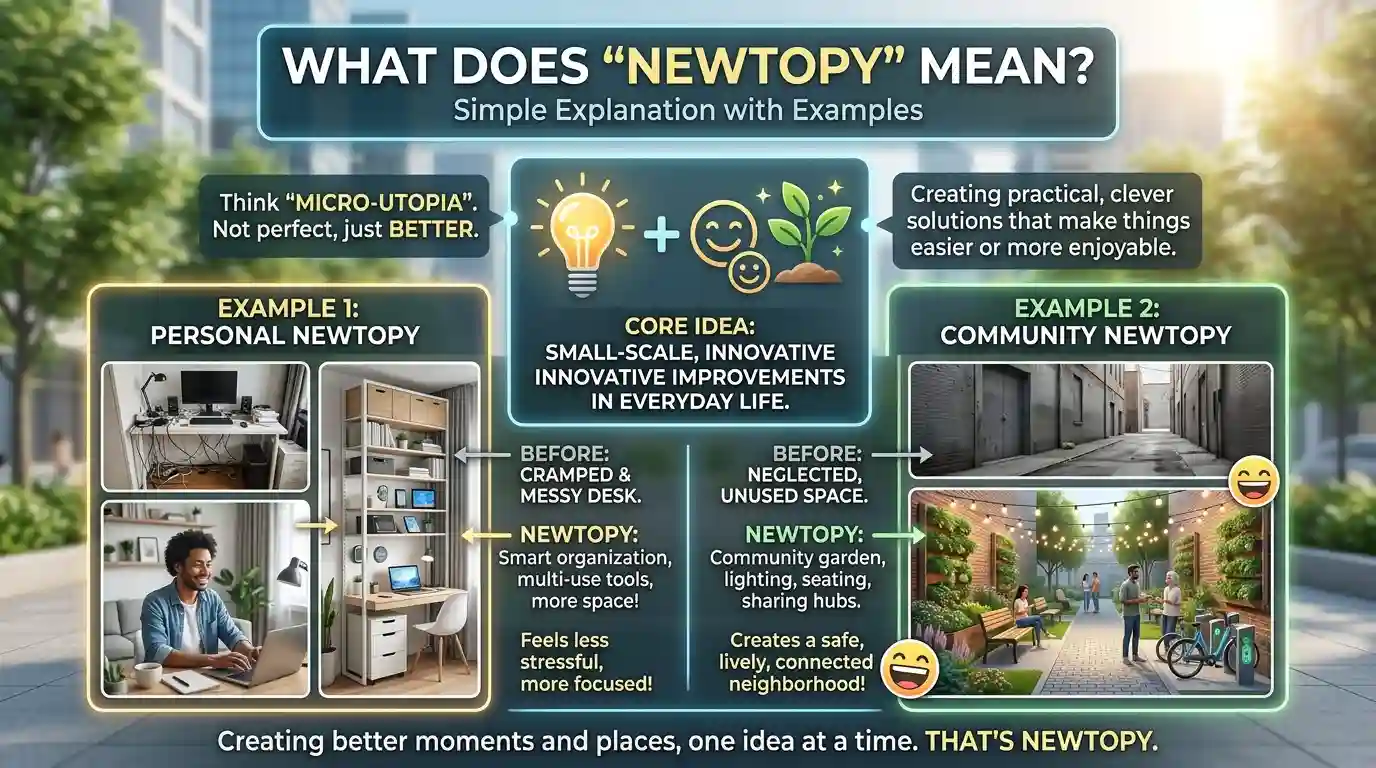
Across these examples, the word acts more like a feeling or an idea than a specific object. You cannot point to it, download it, or purchase it directly. This is the most important thing to understand about newtopy: it currently works more like an adjective that describes an aspiration than a noun that represents a specific thing.
Common Mistakes and Misconceptions
Mistake #1: Assuming it’s an official tech industry term. It hasn’t been adopted by any standards body, research institution, or major tech company as an official label. If a page tells you “the tech industry defines it as…” without citing a specific, named, verifiable source, treat that claim as unsupported.
Mistake #2: Treating every article about it as independently researched. Because the word surged in search interest quickly, a large share of the content ranking for it was produced fast, by multiple sites, using similar AI-assisted workflows. That’s why so many explanations sound alike — they’re often drawing from the same shallow pool of prior articles rather than original reporting or firsthand product knowledge.
Mistake #3: Confusing it with existing, unrelated terms. Because it sounds similar to other words, some searchers land on completely unrelated results — a Korean drama title, an unrelated brand name, or an entirely different neologism — and mistakenly assume they’re the same thing. If a definition suddenly starts talking about a TV show or an unrelated product line, you’ve likely wandered into a different topic that just happens to share a similar-sounding name.
Mistake #4: Expecting one settled definition. Because the word is still young, asking “what’s the definitive meaning” is a bit like asking for the definitive meaning of “vibe” or “aesthetic” in the early days those words spread online — there’s a general direction, not a locked-in dictionary entry. Expecting more precision than that will only lead to frustration.
Newtopy vs. Similar Buzzwords: A Quick Comparison
“Newtopy” online, its meaning will usually depend on the specific context in which it is being used. It helps to see the term next to other buzzwords it gets lumped in with, since the differences are more about maturity and specificity than meaning. Looking at these side by side also makes it easier to predict where a term like this typically ends up: either it fades once search interest cools, or a specific product, author, or community eventually claims it and gives it real staying power.
| Term | Origin | Level of Definition | Typical Use |
| This word | Blend of “new” + “utopia,” recent online coinage | Loose, still forming | Calmer platforms, all-in-one tools, adaptive mindset |
| “Metaverse” | Coined in 1992 fiction, later adopted by major tech companies | Contested but more concrete, tied to specific products | Immersive virtual/AR environments |
| “Digital minimalism” | Coined by an author in a published book | Clearly defined, single origin | Intentional, reduced tech use |
| “Web3” | Grew from blockchain and crypto communities | Debated but tied to specific technical features | Decentralized apps, tokens, blockchain infrastructure |
| “Agile” | Formalized in a named 2001 manifesto by named authors | Extremely well-defined, documented origin | Iterative software development methodology |
Frequently Asked Questions
Is “Newtopy” a real word you’d find in a dictionary?
No, “Newtopy” is not currently recognized as a standard English word in major dictionaries such as Merriam-Webster, Oxford, or Cambridge. It appears to be a coined term, brand name, username, or an internet-created word rather than an officially established dictionary entry. If you encounter
Who invented the term?
There’s no single credited creator. It appears to have emerged organically across multiple blogs and content sites around the same time, which is why definitions vary so much from source to source instead of tracing back to one origin.
Is it the name of a specific app or company?
Not exclusively. Various small businesses or projects may use similar names, but no single, dominant, universally recognized product currently owns the term the way “Slack” owns messaging or “Zoom” owns video calls.
Why do so many “definition” articles about it sound the same?
Because a lot of them were produced quickly, around the same search trend, often with AI assistance, and frequently draw on the same shallow pool of earlier articles rather than original research or firsthand expertise.
Should I use this word in professional writing?
Use it carefully. Since it doesn’t have a fixed, widely recognized meaning yet, using it in formal writing risks confusing readers. It’s more appropriate in casual contexts, like describing a vibe or direction, than in precise technical or business documentation.
Does it have anything to do with a TV show?
Not directly, though a similarly spelled title exists in unrelated entertainment content, which occasionally causes search confusion. If an article you’re reading suddenly shifts into plot summaries, you’ve likely crossed into that separate topic.
Conclusion
So what does newtopy actually mean?Right now, newtopy is less of a fixed term and more of a mood. People use it to describe calmer online spaces, all-in-one productivity tools, or an adaptive way of thinking. Its meaning changes depending on who uses it and the situation. The word gets its emotional appeal from an old literary idea about a “good place that does not exist.”
At the same time, it connects with a growing demand for simpler and more human-centered technology. Be cautious with any article that claims to provide the “one true definition” of newtopy. No official definition exists yet. What we can explain clearly is the word’s origin, its current uses, and the reasons behind its rapid spread.
