

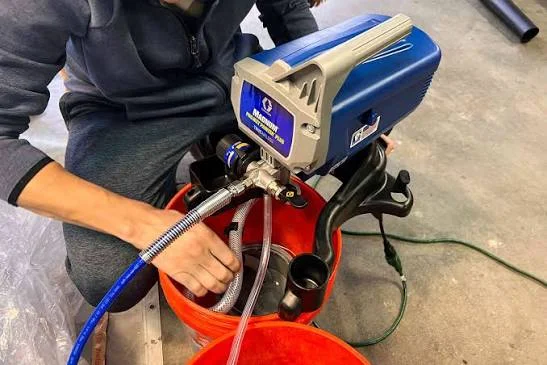
Spec sheets tell you what a graco magnum x7 weighs and what pressure it hits. They don’t tell you what it’s actually like to own one through two full painting seasons — the jobs it handles effortlessly, the ones that push it, and the small habits that separate an X7 that’s still running strong in year three from one that’s already showing its age.
Where the X7 Proves Its Worth
The X7’s higher flow rate and wider tip range compared to entry-level sprayers become obvious the first time you tackle a full exterior. Siding, trim, and fascia in one continuous pass move noticeably faster than they would through a smaller machine, and the wheeled cart means you’re pushing the unit around the property rather than hauling it. On a typical two-story home, that combination is often the difference between finishing a full exterior in a weekend versus stretching the job into a third day.
Elastomeric and masonry coatings are the other place the X7 earns its keep. These materials run thicker than standard latex, and it’s exactly where entry-level pumps start to strain. The X7 handles them without the constant pressure drops that turn a coating job into a maintenance headache.
The First-Season Learning Curve
Most new X7 owners underestimate how different the pressure settings feel compared to a smaller sprayer. The higher flow rate means settings that felt right on an entry-level machine are often too aggressive here. The fix that consistently works: start low, increase gradually while watching the fan pattern on a test surface, and stop as soon as the tails at the pattern’s edges disappear. It typically takes one job to get a feel for it, and after that it becomes second nature.
What Wears First, and When
Because the X7 tends to see more total hours than smaller sprayers — bigger jobs, more frequent use — its wear pattern shows up sooner in raw hours, even though the parts themselves aren’t any less durable. Filters clog first from ordinary use. Tips wear wider over a season or two and need replacing to maintain a clean pattern. And a prime valve that suddenly won’t hold after winter storage is, almost always, a quick and inexpensive fix rather than a sign of real trouble.
- Check the gun filter and inlet strainer every session on high-volume jobs, not just weekly
- Keep a spare tip on hand — running a worn tip too long strains the pump unnecessarily
- Store with Pump Armor before any gap longer than a few days
- Flush thoroughly immediately after every session, especially longer job-site days
The Maintenance Habit That Actually Extends Its Life
The single biggest factor in how long an X7 lasts isn’t how many gallons run through it — it’s what happens in the minutes right after the last coat goes on. On longer job-site days, it’s tempting to let the machine sit while you wrap up other tasks. That gap is exactly where packings dry out and pumps start priming poorly the next time out. Owners who flush immediately, every time, consistently get more years out of the same machine than owners who let it slide “just this once.”
Is It Still the Right Machine Two Seasons In?
For anyone doing full exteriors regularly, running thicker coatings, or painting several properties a year, the answer stays yes well past the first season. The wheeled cart, wider tip range, and higher flow rate that made it the right buy on day one are the same things that keep it earning its cost every season after. It’s not a machine that gets outgrown quickly — most owners who buy the X7 for the right reasons are still reaching for it years later, restocking magnum x7 parts as routine maintenance rather than emergency repairs.
Frequently Asked Questions
Does the X7 need different maintenance than smaller Graco sprayers?
The core routine is the same — flush immediately, check filters regularly, store with Pump Armor — but because it typically logs more hours, that routine matters on a tighter schedule.
How long does the pressure learning curve usually take?
Most owners feel comfortable after one job. Starting low and adjusting up while watching the fan pattern is the fastest way to dial it in.
Is the X7 worth it if I only paint once or twice a year?
For occasional single-feature projects, a smaller sprayer is usually the more sensible buy. The X7 earns its price on full exteriors and thicker coatings.
What’s the most common issue after the X7 sits in winter storage?
A prime valve that won’t hold — nearly always a quick, inexpensive fix rather than a sign of a bigger problem.
