

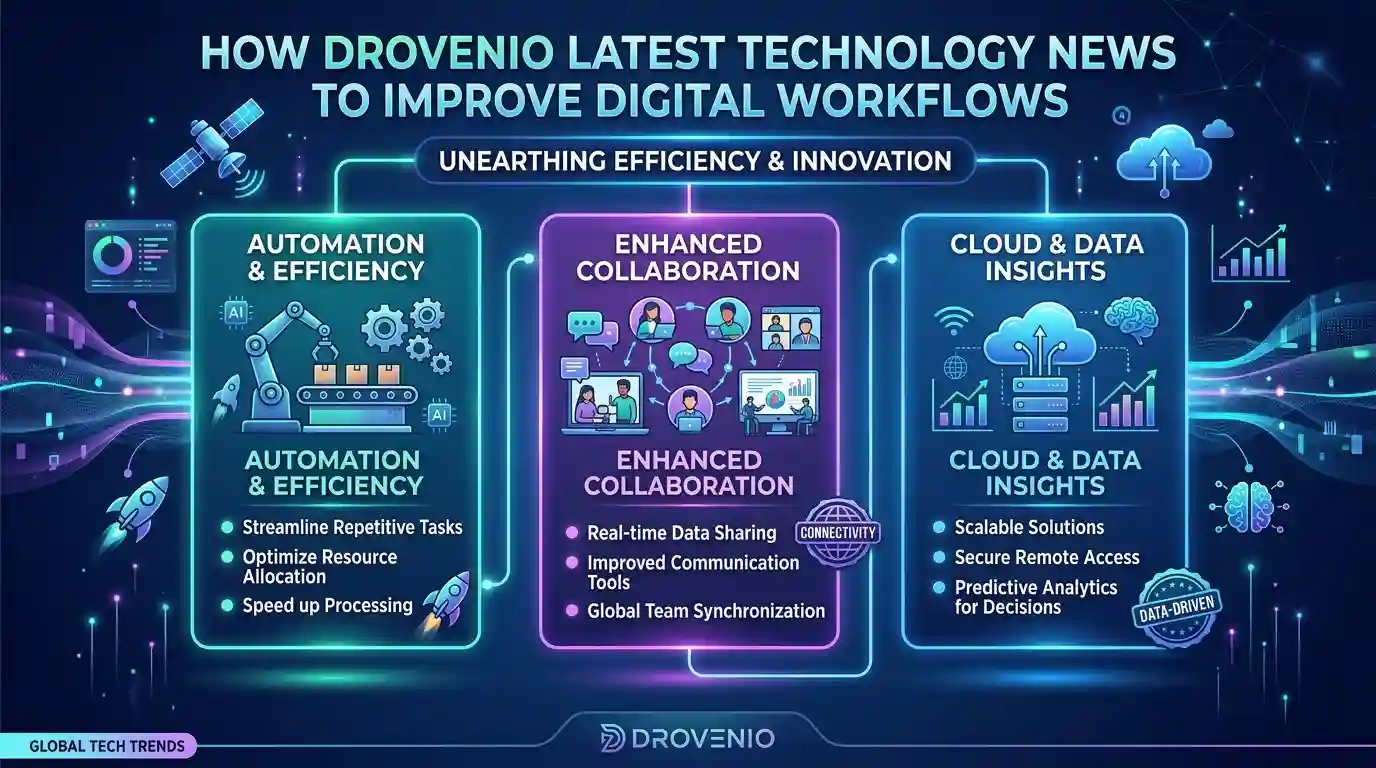
This is where modern digital workflow solutions are gaining attention. Businesses are looking for smarter ways to organize tasks, manage information, automate repetitive actions, and help teams work with fewer interruptions. The growing interest around drovenio latest technology news reflects this shift toward improved workflow systems and technology-driven operations.
A company can lose hours every week because employees switch between disconnected tools, repeat manual tasks, or search for information stored in different systems. The problem is not always a lack of technology. Often, the issue is that existing tools do not work together efficiently. Drovenio represents the type of technology discussion focused on how digital processes can become more organized and adaptable. From workflow automation to connected platforms, businesses want solutions that reduce complexity and improve daily operations.
What Is Drovenio and How Does It Relate to Digital Workflows?
The discussion around drovenio latest technology news highlights the increasing demand for systems that make business operations more flexible. Companies are no longer interested only in faster software. They want technology that understands how their teams actually work.
A strong digital workflow usually includes several important elements:
- Automated task management
- Real-time information sharing
- Data synchronization between platforms
- AI-assisted recommendations
- Better reporting and analytics
- Reduced manual work
The value of these systems comes from improving everyday activities. For example, a marketing team can automate content approvals, a finance department can speed up invoice reviews, and customer support teams can organize requests more efficiently.
The main purpose is not to remove human involvement. Instead, technology handles repetitive steps so employees can spend more time on decision-making, creativity, and customer relationships.
How Modern Technology Improves Digital Workflows
1. Workflow Automation Reduces Repetitive Tasks
One of the biggest advantages of modern workflow technology is automation. Many businesses still spend significant time completing repetitive activities that do not require complex decision-making.
Examples include:
- Sending confirmation emails
- Updating customer records
- Creating reports
- Assigning tasks
- Processing approvals
- Organizing documents
Automation systems allow companies to create rules that complete these actions automatically. Instead of employees manually moving information between platforms, technology manages the process based on predefined instructions.
For example, when a customer fills out a contact form, an automated workflow can send a confirmation message, create a customer profile, assign the inquiry to the correct employee, and schedule follow-up reminders.
This reduces response times and lowers the chance of human mistakes.
The ideas discussed in drovenio latest technology news connect strongly with this movement because businesses increasingly want technology that supports practical improvements rather than simply adding more features.
2. Artificial Intelligence Makes Workflows More Intelligent
Artificial intelligence has changed how companies think about digital workflows. Earlier systems mainly followed fixed instructions. Modern solutions can analyze information, identify patterns, and support better decisions.
AI can improve workflows in several ways:
Smart Recommendations
AI systems can analyze previous actions and suggest the next step. For example, project management tools can recommend deadlines based on previous projects or highlight tasks that may cause delays.
Document Processing
Businesses handle thousands of documents every year. AI-powered systems can extract important details from invoices, contracts, and forms without requiring employees to enter information manually.
Customer Support Improvements
AI tools can categorize customer requests, suggest responses, and route complex issues to the correct department.
These improvements help companies create faster and more organized operations.
The latest discussions around drovenio latest technology news often reflect a broader technology trend: businesses want AI that solves real workflow problems instead of technology that exists only for demonstration.
AI does not replace the need for human judgment. Instead, it provides additional support by handling repetitive analysis and organizing information.
A company using AI correctly can help employees make decisions faster while maintaining human oversight where it matters most.
For example, a healthcare organization may use AI to organize appointment requests, but medical professionals still make important treatment decisions. A financial company may use AI to identify unusual transactions, but experts review final outcomes.
The combination of human expertise and intelligent technology creates stronger workflows.
3. Cloud-Based Systems Improve Collaboration
Modern businesses often operate across different locations. Employees may work remotely, teams may exist in multiple cities, and customers may interact through various digital channels.
Cloud-based workflow systems help solve these challenges by allowing teams to access information from anywhere.
Instead of storing important files on individual computers, cloud platforms provide shared access with proper permissions. Team members can review documents, update tasks, and communicate without waiting for physical transfers.
Benefits of cloud-based workflows include:
- Faster collaboration
- Easier access to information
- Better data security controls
- Lower infrastructure costs
- Improved scalability
For example, a software development team can use cloud-based project tools to track tasks, review code updates, and manage releases. A marketing team can collaborate on campaigns without exchanging multiple versions of files through email.
The growing attention around drovenio latest technology news shows how businesses continue moving toward connected digital environments where information flows more freely.
Cloud technology also supports business growth. A small company can start with basic workflow tools and expand its systems as operations become more complex.
This flexibility makes cloud-based workflows useful for startups, growing companies, and large organizations.
However, businesses must choose platforms carefully. Security settings, user permissions, and data management policies play an important role in protecting sensitive information.
A well-designed cloud workflow creates better teamwork without sacrificing control.
4. Data Integration Creates Connected Business Processes
Many businesses struggle because their tools operate separately. A company may use one platform for customer management, another for accounting, another for communication, and another for project tracking. When these systems do not share information, employees often spend time transferring data manually.
Digital workflow technology focuses on connecting these systems. Integration allows different platforms to exchange information automatically and keep records updated across the organization.
For example, when a customer purchases a service, an integrated workflow can:
- Update the customer database
- Notify the sales team
- Create an invoice
- Start customer onboarding
- Schedule follow-up communication
This eliminates repeated data entry and reduces delays.
The ideas covered through drovenio latest technology news reflect a larger movement toward connected business systems. Companies want technology that allows different departments to work from the same information instead of relying on separate databases.
Data integration also improves decision-making. When information comes from multiple sources and appears in one place, managers can identify trends more easily.
For example, a business owner can view sales performance, customer feedback, and operational data together. This provides a clearer picture of what works and what needs improvement.
However, integration requires proper planning. Businesses should evaluate their existing systems before connecting new tools. Poor integration can create duplicate records, security issues, or inaccurate information.
A successful digital workflow depends on reliable data flow. When systems communicate properly, employees spend less time managing information and more time using it.
Real-World Examples of Digital Workflow Improvements
Example 1: A Marketing Agency Managing Client Projects
A marketing agency may handle dozens of clients at the same time. Without organized workflows, teams often struggle with missed deadlines, unclear responsibilities, and repeated communication.
A digital workflow system can improve the process by creating a structured path:
- A client submits a project request.
- The system assigns the task to the correct team member.
- Designers, writers, and managers receive notifications.
- Approval steps happen through one platform.
- Final files are delivered automatically.
This approach reduces confusion and creates better visibility for everyone involved.
Instead of searching through emails or chat messages, employees can see project status in one place.
Example 2: Healthcare Organizations Improving Patient Management
Healthcare providers handle sensitive information and complex schedules. Manual processes can create unnecessary delays.
A digital workflow can help clinics manage:
- Appointment scheduling
- Patient reminders
- Medical record organization
- Billing processes
- Follow-up communication
For example, after a patient books an appointment online, an automated system can send confirmation details, prepare necessary forms, and notify staff members.
This allows healthcare workers to spend more time focusing on patient care rather than administrative tasks.
The technology discussions surrounding drovenio latest technology news show why industries with complex processes continue exploring better workflow systems.
Example 3: Manufacturing Companies Improving Production
Manufacturing companies often depend on accurate timing and coordination. A delay in one department can affect the entire production chain.
Digital workflows help manufacturers monitor:
- Inventory levels
- Equipment performance
- Production schedules
- Quality checks
For example, if inventory reaches a low level, an automated system can alert the purchasing team before production stops.
This type of proactive workflow reduces downtime and improves efficiency.
Common Mistakes Businesses Make When Improving Digital Workflows
1. Adding Technology Without Fixing Existing Problems
One common mistake is buying new software without understanding current workflow issues.
Technology cannot automatically solve poor processes. If a company has unnecessary steps, unclear responsibilities, or weak communication, adding another tool may create more confusion.
Businesses should first analyze their current workflow and identify areas that need improvement.
2. Choosing Too Many Tools
Many organizations use multiple platforms because each tool solves a small problem. Over time, employees may need to manage too many systems.
This creates:
- More passwords
- More training requirements
- More data duplication
- More confusion
A better approach is choosing tools that work together and support the company’s actual needs.
3. Ignoring Employee Training
Even the best workflow technology will fail if employees do not understand how to use it.
Companies should provide proper training and explain why the new system benefits daily work.
When employees understand the purpose behind a workflow change, adoption becomes easier.
4. Forgetting Security Requirements
Digital workflows involve important business information. Security should always remain a priority.
Companies should consider:
- Access permissions
- Data encryption
- Regular security reviews
- Employee awareness training
A faster workflow is valuable only when it protects important information.
Digital Workflows vs Traditional Workflows: Key Differences
| Traditional Workflows | Digital Workflows |
| Depend heavily on manual tasks | Use automation for repeated activities |
| Information may exist in separate places | Data connects across systems |
| Updates require manual communication | Teams receive automatic notifications |
| More chances for human errors | Better accuracy through structured processes |
| Difficult to track progress | Real-time monitoring and reporting |
Traditional workflows are not always ineffective. Small businesses with simple operations may manage well with basic processes.
However, as organizations grow, digital workflows become more valuable because they provide better control and visibility.
The focus of modern workflow technology is not simply replacing older methods. It is improving how people complete work.
Frequently Asked Questions (FAQ)
What is the purpose of digital workflow technology?
Digital workflow technology helps businesses organize tasks, automate repetitive processes, and connect different systems. It improves communication, reduces manual work, and allows teams to complete projects more efficiently.
How does Drovenio relate to modern technology trends?
Drovenio is associated with discussions about improving digital processes through modern technology. It reflects the growing interest in automation, connected platforms, and smarter ways to manage business operations.
Can small businesses benefit from digital workflows?
Yes, small businesses can use digital workflows to save time and improve organization. Even simple automation, such as customer follow-ups or task management, can create noticeable improvements.
Does workflow automation replace employees?
No. Workflow automation mainly handles repetitive tasks and helps employees work more efficiently. Human decision-making, creativity, and problem-solving remain important parts of business operations.
What industries benefit most from digital workflows?
Almost every industry can benefit, including healthcare, marketing, manufacturing, finance, education, and retail. Any organization with repeated tasks and information management needs can improve through better workflows.
How can companies start improving their workflows?
Companies should begin by reviewing existing processes, identifying problems, selecting suitable tools, and training employees. Small improvements can create significant results over time.
Why are businesses focusing more on connected technology?
Businesses want systems that reduce complexity and improve productivity. Connected technology helps organizations share information, automate tasks, and make better decisions using accurate data.
Conclusion
Digital workflows are becoming an important part of how businesses organize and complete work. Companies are moving away from disconnected systems and manual processes toward technology that improves collaboration, automation, and information sharing.
The growing interest around drovenio latest technology news represents a wider shift toward practical technology solutions that help organizations work smarter. The value comes from creating better processes, not simply adding more software.
Businesses that carefully plan their workflow improvements can reduce wasted time, improve accuracy, and create better experiences for employees and customers.
The future of digital operations will depend on how effectively companies combine automation, artificial intelligence, cloud systems, and human expertise. Technology works best when it supports people and makes everyday work easier.
